100 stories from the hiking route
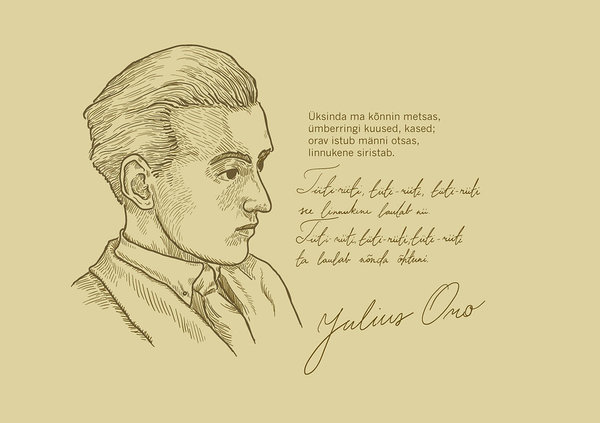
1926 – writer Julius Oro starts working as a teacher at Vasalemma School
Julius Oengo was born in Suuremõisa rural municipality in Hiiu County as the son of a sea captain. In 1923, Julius Oengo moved to Tallinn and from there to Vasalemma in 1926.In 1936, he discovered that his name appears in three different variations – Oengo, Öngo, Õngo – in municipal registers and started using Õngo, as it sounded the most Estonian and best corresponded to the patriotic spirit of the era. However, the literary community still knew him as Julius Oengo and the covers of children’s books sported J. Oro instead.
Julius Oro published several rhyme books for children and was the co-author of several reading and spelling books. In 1923–1934, he worked as the editor of the magazine Laste Rõõm.
The most renowned of his poetry books is “Muna” (1938) that has been translated into Finnish, Hungarian, Russian and Swedish. Julius Oro’s children’s poetry is also popular today and it has been used in several children’s songs.
On 24 August 1941 Julius Oro was taken from his home by Russian soldiers with the excuse of needing an interpreter. According to the rumours, the writer was executed in Paldiski a few days later.
×
![1926 – writer Julius Oro starts working as a teacher at Vasalemma School]()
Topic
Coordinates
Long-Lat WGS 84
Latitude: 59.2300611
Longitude: 24.251189L-EST 97
x: 6565769.7
y: 514340.4
Location
Peraküla-Aegviidu matkatee