100 stories from the hiking route
2011 – concert tour “Valge laev” (White Ship) of ensemble Lindpriid
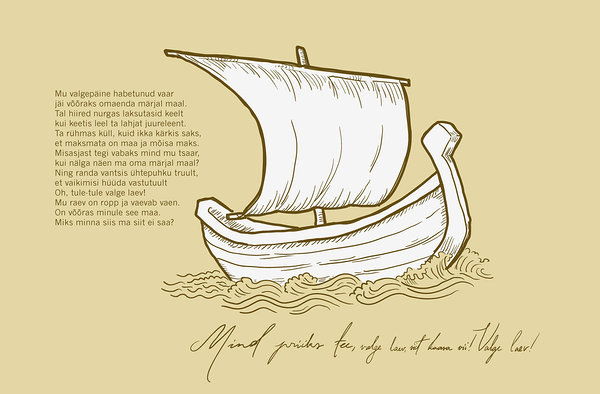
My white-headed bearded grandpabecame a stranger in his own land.
The mice in the corner clicked their tongues,
as he boiled a watery broth of roots.
He toiled but still the master of the manor barked
that the tax for land and manor has not been paid.
What did my czar free me for,
if I see hunger in my land?
And so he faithfully kept trudging to the beach
to silently call upwind:
“Oh, come, come, white ship!
My rage is foul and vexed with wrath.
This land is foreign to me.
Why can I not leave?
Make me free, white ship, take me with! White ship!”
This is the translation of the verse from the song “White Ship” by Lindpriid.
Thanks to Eduard Vilde’s “Prohvet Maltsvet” (Prophet Maltsvet), the white ship has become a commonly used symbol in Estonian cultural history, signifying a yearning for a better life and the possible failure of such hope. The historical parallels can be seen both in the mass-fleeing over the Baltic Sea (mostly to Sweden) during the Second World War and in the passenger ship “Georg Ots” which was the first one to navigate between Estonia and Finland, helping to restore the connections broken during the Soviet era. To some extent, the symbol can be transfused into the contemporary dream of finding a better life on the other side of the Gulf of Finland.
About 300 metres north of the hiking route is the site of the former Kääni farm where Juhan Leinberg (1812–1885), on whose life Vilde’s novel is based, was born. In 1862, the prophet, named after the Maltsvet farm, wished to lead his followers to Crimea, the so-called Promised Land.
×
![2011 – concert tour “Valge laev” (White Ship) of ensemble Lindpriid]()
Topic
Coordinates
Long-Lat WGS 84
Latitude: 58.918663
Longitude: 26.033943L-EST 97
x: 6532832.0
y: 617152
Location
Ähijärve-Aegviidu matkatee