100 stories from the hiking route
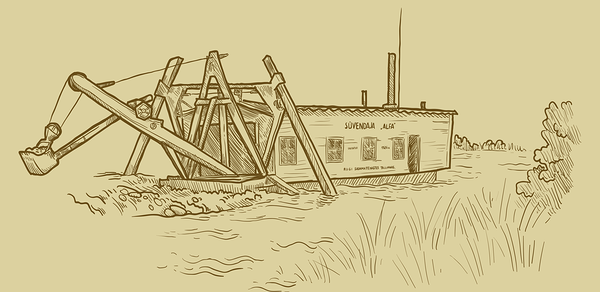
1926 – Excavator Alfa started dredging the Kasari River
Before the dredging, Kasari River branched into several affluents before flowing into the Gulf of Matsalu, creating an extensive delta. There were broad flood-meadows on both sides of the river. The long flooding period, that covered at it’s peaks an area of 112 km2, hindered the haying and interfered with the lives of locals. That is why the dredging of the flood-meadow was started in the 1920s.On 24 August 1926, half a kilometer downstream from Kasari Bridge, excavator Alfa, specially designed for this use, started the dredging work. In the winter another excavator, Beta, of the same type was finished. The riverbed turned out to be so hard that the excavator could not work without the help of explosives. One shift of the excavator consisted of 3 people and the dredging of Matsalu rivers took altogether 12 years.
As a result, the floods on the meadows of Kasari River decreased substantially. Another outcome, however, was that the nutritious sediment did not end up on the flood-meadows and a noticeable drop in the meadow hay harvest followed already 5–6 years after the dredging. The greatest change accompanying the dredging is the disappearance of the North-eastern bay of the Gulf of Matsalu, where the sea subsided and was replaced by more regular meadow associations already ten years after the dredging.
×
![1926 – Excavator Alfa started dredging the Kasari River]()
Topic
Village life and society work
Coordinates
Long-Lat WGS 84
Latitude: 58.7306765
Longitude: 23.9852106L-EST 97
x:
6510116.9
y:
499143.4
Location
Penijõe-Aegviidu matkatee