100 stories from the hiking route
1930 – Piiroja railroad culvert is built
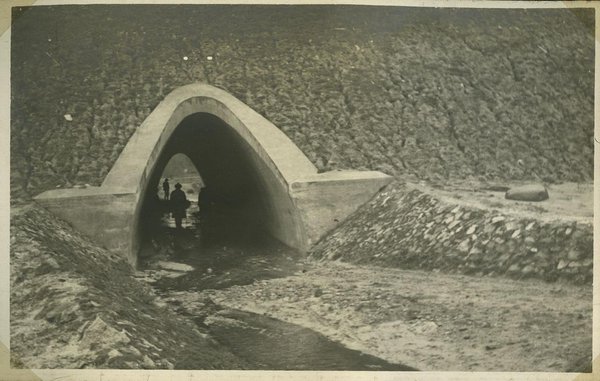
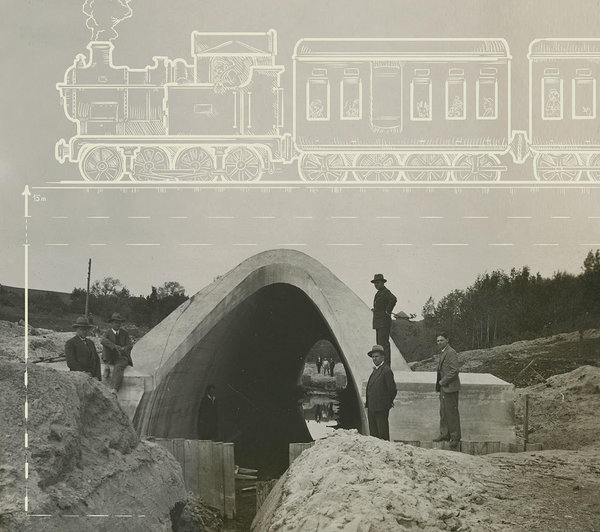
The Piiroja railroad culvert was built in 1930 by the Danish company Højgaard & Schultz (H&S) and is considered one of the most representative culverts built during the pre-war times of the Republic of Estonia.Sven Schultz, one of the founders of the company, was the head of construction at the Tallinn seaplane hangars at the beginning of his career. It was presumably because of his earlier personal contacts that H&S tried to enter the Estonian market in the second half of the 1920s. The Estonian branch of H&S was opened in 1930. H&S then built four reinforced concrete railway bridges on the Tartu-Pechory railroad line as well as the massive Piiroja railroad culvert for their first major commission contract.
The walls of the 60-metre semi-oval vaulted concrete tube of the Piiroja culvert were about a metre thick and carried the 15-metre thick earthworks. The culvert had steel reinforcements on the inside. The concrete of the arch was poured in one go and it took four days to do it. The cost of the Piiroja culvert amounted to 70,000 kroons – an amount that surpassed the prices of many of the bridges built on the same railroad line.
The activities of H&S in Estonia culminated with the National Bridge Building Programme. In 1935–1938, H&S designed and built seven out of the thirteen bridges set out by the programme. Unfortunately, most of the bridges in Estonia were destroyed during the Second World War and none of the bridges built by H&S survived.
×
![1930 – Piiroja railroad culvert is built]()
Topic
People and nature
Coordinates
Long-Lat WGS 84
Latitude: 57.842613
Longitude: 27.569154L-EST 97
x: 6416844.1
y: 711887
Location
Kauksi-Aegviidu matkatee