100 stories from the hiking route
1931 – Rumba Train Station was opened
In the 1920s, there was a growing need for connectivity to the Tallinn-Pärnu railroad. The new railway was to go from Rapla through Märjamaa and Lihula to Virtsu Port. The construction of Rapla–Virtsu narrow-rail railway started in 1928. Most of the soil-work was done by the autumn of 1930, but there were difficulties with the Rumba Bridge, where a large amount of soil had to be carried from distant locations for the construction of the dam due to the lack of stones or proper construction sand nearby. The Rumba village residents protested against the initial railroad destination, and after assessing the situation, the destination was changed.The 96-kilometer Rapla–Virtsu railroad line was opened on 1 December 1931 and was operational until 1968. In 1935–1936, on average, 42,000 train tickets were sold at the ticket offices. Colloquially named Virtsu Express, the train took a little over three hours to get from Virtsu to Tallinn and it was the main way of getting to the capital for the inhabitants of the island of Saaremaa.
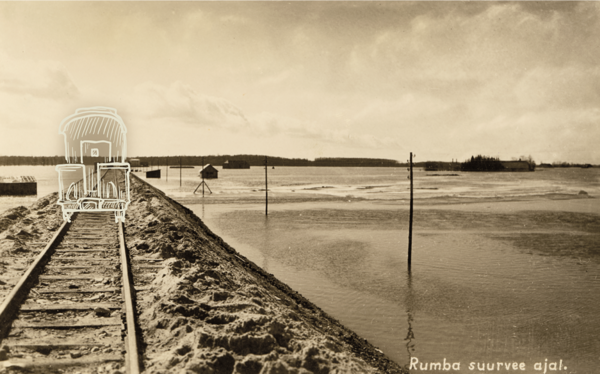
The Rumba half station was built on the side of the Kasari River. Hence, the station was under a constant risk of flooding, during which the only way to get to the station was by boat. The station was completed in 1931 based on the same design as the stations of Paeküla, Rootsi, and Tuudi. After the railroad closure, the building has been used as living quarters.
×
![1931 – Rumba Train Station was opened]()
Topic
Village life and society work
Coordinates
Long-Lat WGS 84
Latitude: 58.7296440
Longitude: 24.1458679L-EST 97
x:
6510011.0
y:
508448.9
Location
Penijõe-Aegviidu matkatee