100 stories from the hiking route
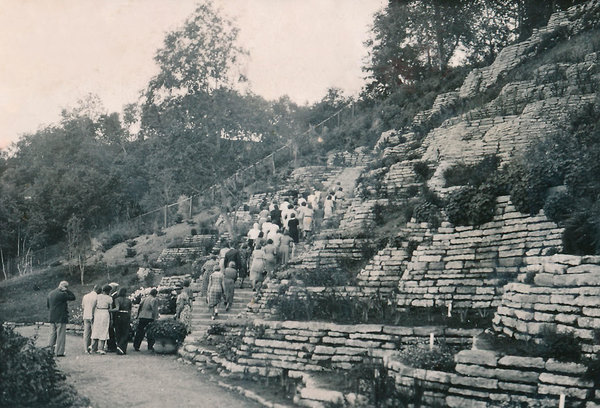
1937 – the construction of Europe’s largest rock garden near Oru Castle began
The idea to build a rock garden came from President Konstantin Päts. The construction of the rock garden took two years. As the slate shore was in danger of caving in on that spot, the work had to start with fortifications by building a support wall and drainage. The fortification work was followed by building the stone blocks and planting on them. The construction of the stone garden took a total of 800 cubic metres of rocks.Only domestic species were planted in the rock garden – more than a hundred in total. Every plant had a sign with its Latin name on it. E. Leemets, gardener of Oru, explained:
"We were not planning on bringing exotica to this crisp northern shore. The stone garden is the same natural slate shore, just stylised. By joining large stone blocks, we have tried to express the ancient might of the cliff, characteristic to the Viru slate shore in general."
A miniature waterfall flowing down to the limestone pool and there on to the sea, was formed from three springs. Goldfish inhabited the pool and a female statue by A. Jasmin was set up by it. Limestone benches suitable for the environment were built and placed under the larger trees offering shade. A limestone steps lead down to the seaside. The Oru Castle rock garden was supposedly the largest in Europe in its time.
×
![1937 – the construction of Europe’s largest rock garden near Oru Castle began]()
Topic
Village life and society work
Coordinates
Long-Lat WGS 84
Latitude: 59.4234906
Longitude: 27.5383602L-EST 97
x:
6592587.8
y:
700776.3
Location
Kauksi-Aegviidu matkatee