100 stories from the hiking route
1960 – 835 tonnes of resin is extracted from Estonian forests
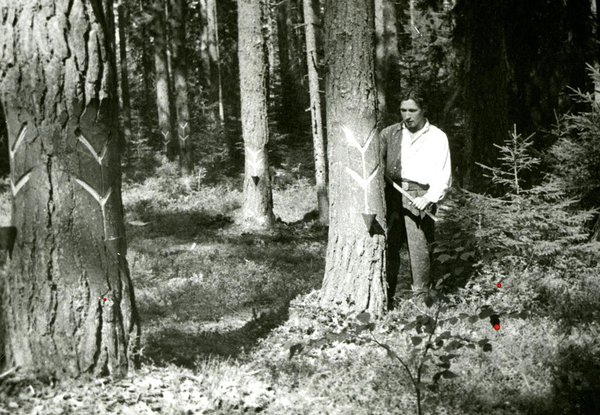
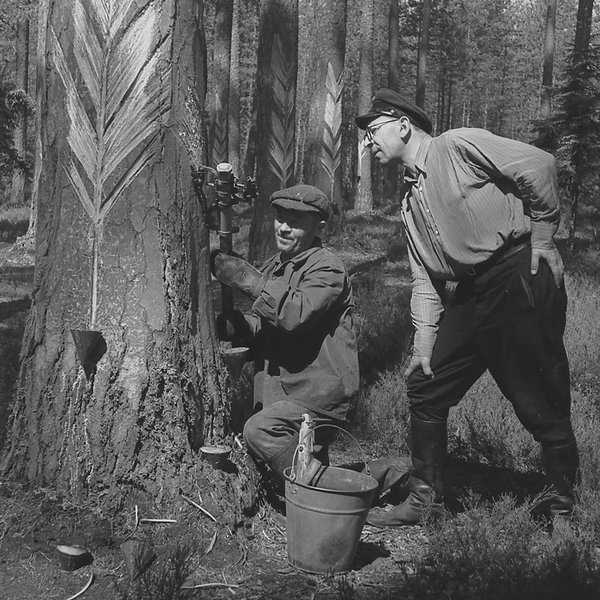
Several resin extraction plots are located by the hiking route in Rassi Village. Resin has a protective function in coniferous trees: it flows into the wounds inflicted on the tree, stopping the invasion of pathogens and pests.People have used resin throughout time. In the early days, they used it to treat wounds and make brushes; nowadays, however, it is a raw material in the chemical industry. Collecting resin from the wounds cut into the trunk of a pine is called resin extraction.
Resin extraction was first tested in Estonia after the First World War but the intensive industrial resin production in Estonia began in the second half of the 1940s. Over 100 tonnes of resin was produced as early as in 1949. The largest quantity of resin was produced in 1960 when 835 tonnes of the substance was gathered. Resin production diminished after that due to the reduction of prescribed cuts and extensive damage from a storm in 1967.
According to Jaak Leiman, one of the most prolific resin extractors of the Türi Forest Combine, the job was suitable for reclusive people, as it meant working alone and being in the nature for the whole summer. Jaak Leiman was often friendly with the common adder, as well as snakes to whom he offered milk that they liked a lot. A resin extractor’s wages were only a little bit smaller than the incomes of sailors.
Sources:
Välja, A. 1981. Vaigutamine ja puidu keemiline töötlemine. I osa . Vaigutamise bioloogilised ja tehnilised alused.
×
![1960 – 835 tonnes of resin is extracted from Estonian forests]()
Topic
The story of forestry
Coordinates
Long-Lat WGS 84
Latitude: 58.6115888888889
Longitude: 25.3108888888889L-EST 97
x: 6497597
y: 576180.5
Location
Ikla-Aegviidu matkatee